Necklace Styling: Balance, Length & Proportion
The Necklace Detail People Often Miss
I spend most of my time thinking about making jewelry — how a piece is built, how it lays or hangs, how can really make the stone I am working with shine. But recently, something caught my attention that had nothing to do with fabrication and everything to do with styling.
It was a simple idea, but it stuck with me:
necklaces don’t just decorate an outfit — they guide the eye and complete the whole look.
We’ve all noticed her. Maybe passing by on the street, grabbing coffee, or walking through a shop. Her outfit isn’t complicated or overdone, but everything feels balanced. Nothing looks forced. Your eye knows exactly where to land. She doesn’t look like she’s trying — she just looks right.
There’s no single secret behind that kind of ease, but jewelry plays a powerful role. It acts as a kind of punctuation — the finishing mark that pulls everything together. Where a necklace begins and ends quietly shapes how a look reads. It influences what you notice first, where your eye pauses, and whether an outfit feels intentional or slightly off, even when all the individual pieces are beautiful on their own.
That idea is what sparked this post.
Where It Ends, the Eye Stops
Every necklace creates a visual path. The eye naturally follows the line of the chain until it reaches a stopping point — a pendant, a drop, the end of a strand.
That stopping point matters more than we tend to realize.
If it lands too high, the look can feel tight or unfinished.
If it falls too low, the connection breaks and the piece can disappear into the outfit.
When it lands just right, everything suddenly feels balanced.
This is true whether you love bold statement pieces or delicate, minimal designs.
Starting with the Pendant Necklace
Before layering anything, it helps to look at a pendant on its own.

Different pendant styles naturally pull the eye in different ways:
-
Wider pendants spread attention horizontally
-
Petite pendants keep the focus close and subtle
-
Drop pendants create vertical movement and draw the eye downward
None of these are “better” — they simply create different visual effects. Understanding that gives you control when you start pairing and layering.
Layering success: Support, Not Competition
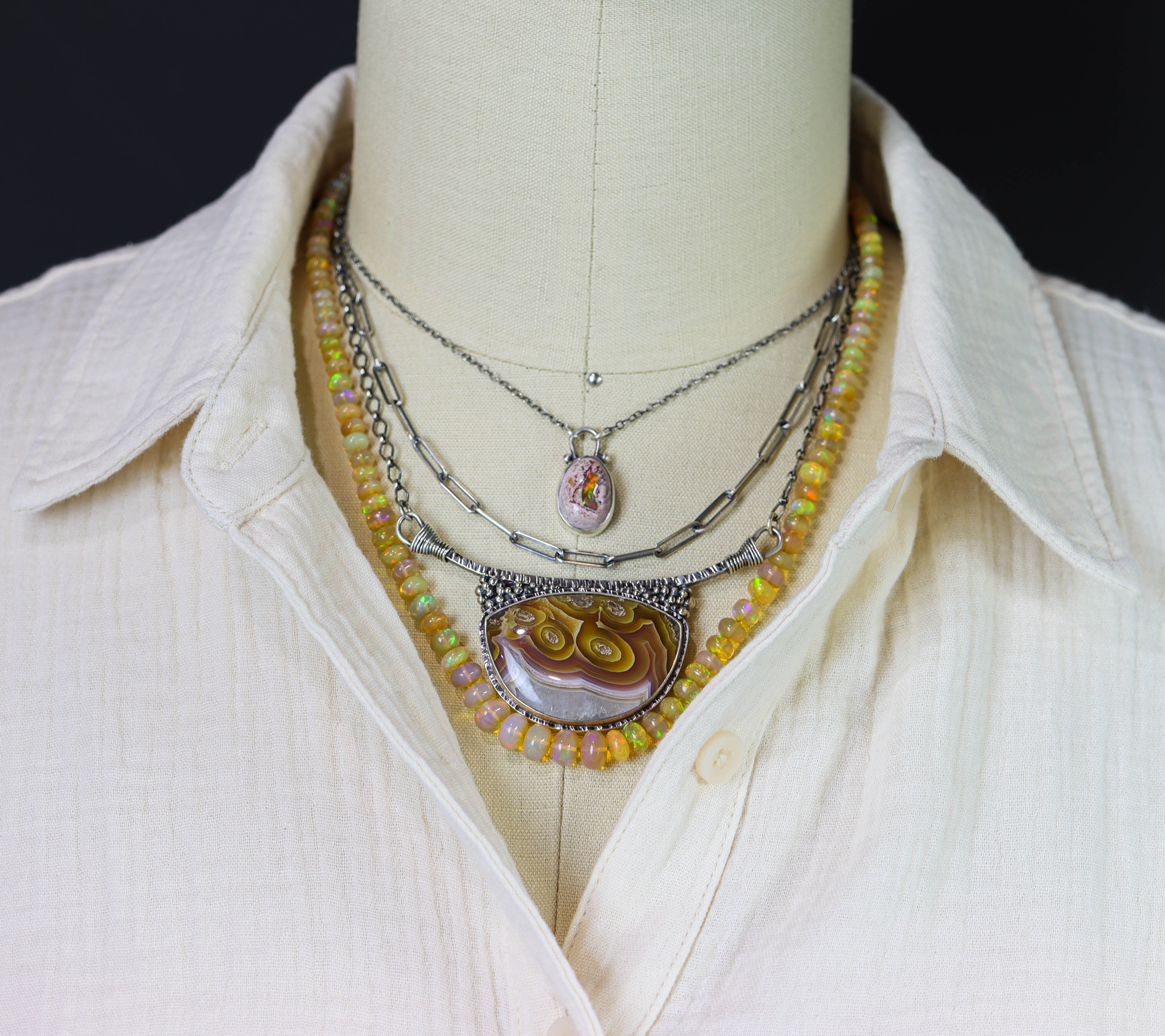
When you add a strand or a second chain, its job isn’t to compete — it’s to support what’s already happening.
A strong pendant often benefits from a softer, framing strand.
A quieter pendant can be lifted by texture or repetition.
Petite pieces shine when they’re given space or echoed in a second layer.
This is why having a mix of lengths and styles matters. Layering works best when each piece has a clear role, even in a simple combination.


Placement Is Everything
Drop pendants are especially sensitive to placement. Even small changes in length can completely change how they read.
At the right height, the drop feels fluid and intentional.
A little too low, and the visual connection breaks.
That’s why many of my pendants are paired with my favorite diamond link chain. Being able to hook the clasp into different links lets you fine-tune the length — not just for different necklines, but for how your shirt opens or how layers sit that day.
Adjustability isn’t a bonus feature. It’s part of how the design works.

Final Thoughts
I hope these ideas were helpful — and that they give you something to think about the next time you’re getting dressed. Not in an overcomplicated way, but in an intuitive one.
Necklaces have a way of changing the entire feel of an outfit. A small shift in length, scale, or pairing can bring balance, draw the eye, and pull a look together in a way that feels intentional rather than quickly thrown together as an afterthought.
If this post helps you look at your jewelry a little differently — experimenting, adjusting, or trusting your eye a bit more — then it’s done exactly what I hoped it would.
If you have a styling question or a situation you’d like me to explore in the future, you’re always welcome to leave a comment or reach out through my website. I read every message, even if I can’t always reply directly here.

Written by Janine Krantz


Leave a comment
This site is protected by hCaptcha and the hCaptcha Privacy Policy and Terms of Service apply.